Tuesday, May 21, 2013

REPOST: Ni No Kuni‘s Lovely Ultima Homage

This article on Time.com shares that the Wizard edition of Ni no Kuni: Wrath of the White Witch came with many goodies that many old-school RPG fans would greatly appreciate. Read about it below:

Image source: techland.time.com


I don’t know for a fact that Ni no Kuni: Wrath of the White Witch director Ken Motomura or writer Akihiro Hino ever fooled with the Ultima computer roleplaying games, but if I had to guess, I’d bet they did. Or someone at Level 5 did, because man, the collector’s edition is like hopping into a time-machine and rolling back to the days roleplaying games actually came with stuff.

No, I don’t mean the sort of post-Todd McFarlane toy porn you get with today’s crazy-priced, limited game editions: monster-sized boxes harboring ornate polymer statues no one has room to display or probably much desire to explain to passerby. “This one is of Alduin the world eater perched on a word wall!” sounds like something 40-year-old Andy Stitzer might say, because it is.

I’m talking about the Wizard Edition of Ni no Kuni, which sold out so fast (the “in stock” disclaimer on the official sale page has been wrong for months) I paid close to three times the asking price to land a copy. It arrived in an unassuming box with a suspiciously Yoshitaka Amano/Final Fantasy-like box logo — an embossed version of the one on the PS3 case sleeve; I was more than a little concerned, prying the cardboard flaps open. I blew my rainy day fund on this?

But stuffed inside was something I hadn’t come across in ages: a suspiciously Ultima-like tome. And I mean tome: I’m talking about a novel-length book, clocking in at over 300 pages (beating even Ultima by a mile) that details the game’s elaborate world, its bestiary (replete with lovely little color sketches), its alchemic and magical systems and so forth. Those of you playing the game (or who’ve long since finished it) know this as the Wizard’s Companion, because the developers were kind of enough to fold it into the actual game and gameplay, where you can unlock pages as you go; find them all, and I’m pretty sure there’s a trophy involved.

Richard Garriott has a thing about this. Those of you who’ve not only played the Ultima games but actually owned them back in the day doubtless remember Origin’s large cardboard boxes stuffed with goodies like little medallions, cloth maps and slender lore booklets — game swag before we called it that. You can get a sense for what that was like from GOG.com, whose updated versions of the Ultima installments include scans of some of the original materials, but it’s not the same as holding something with heft in your hands.

Like Ni no Kuni‘s wizard coin. I know, it’s kind of silly — it’s just a piece of cheap, gold-colored metal pressed into cardboard and sealed in plastic, after all. But there’s something the opposite of chintzy about it, just like Ultima‘s ankhs and Fellowship medallions. The same goes for the gorgeous watercolor sketches on high quality paper by Studio Ghibli artist Yoshiyuki Momose, or the plush toy reproduction of Drippy (your guide in the game). In fact the only letdown is the “Special Music Selection CD” with two of frequent Hayao Miyazaki collaborator Joe Hisaishi’s compositions — the full soundtrack contains 21 tracks, and boy are you missing out if you haven’t picked it up.

That’s it, really — just me tripping down memory lane, remembering when game swag felt distinctive and meaningful, not dashed off at some mass-assembly plant and stuffed in a giant box with lots of styrofoam to sort of spatially justify the triple-digit price tags. Judging from Ni no Kuni‘s instant sales success here in the U.S., Namco Bandai probably could have sold two or three times as many of these things.


 Find more gaming rants and reviews through this Roopanand Rick Facebook page.

Sunday, April 21, 2013

A hundred resets and counting: My 2nd play-through of Fire Emblem Awakening


Hey y’all, it’s Roopanand Rick here again. After 50 hours or so in my first playthrough, I’ve managed to fully enjoy the story and the system of Fire Emblem: Awakening, which is actually my first Fire Emblem game. For those who haven’t tried it out yet, Fire Emblem is known for its fun, tactical RPG elements and its punishing feature – deaths in the game are permanent. In other games, characters can get KO’d and you’d still have time to revive them. Not so in Fire Emblem – once HP hits zero, you’ll have to say goodbye to that character forever.


Image Source: gametrailers.com


Which is why for the longest time, I’ve mostly avoided the Fire Emblem games. I like investing in my characters, especially in RPGs, and it would break my heart to see all my hard work go to waste with one error. Awakening offered me a respite from that nasty feature with its casual mode, allowing me to enjoy the story and its system without the perma-death feature.


Image Source: forbes.com


Upon finishing the story for the first time, I was confident that maybe I could handle the game for all its glory now (albeit still in a lower difficulty setting.) Surprisingly, I did manage to play one or two chapters without much problem. I knew the strengths of my starting characters, I knew which was best at taking damage early on, and I knew I had to protect my primary cleric until she gained a few levels. Still, my knowledge on the game based on my previous playthrough still was not enough to save me from the heartache and the endless trials that were offered by the classic mode.

As of writing, I have had over a hundred game resets because of miscalculations of enemy movement and some errors. My Fire Emblem Awakening avatar, named Paray, still needs to learn a lot in being a tactician in a punishing RPG world where death is permanent.


Video Source: youtube.com


If you’re still interested in how this attempt at classic hardcore gaming turns out for me, then please do follow me on Twitter.

Thursday, March 21, 2013

Repost: NPR - '60s Japan, Aglow 'From Up On Poppy Hill'

While I'm still taking some time to fully enjoy my playthroughs of Ni no Kuni, I just remembered that there was another Studio Ghilbi animated movie that I wanted to share with you guys. Given that I'm currently distracted with a game, I don't think I'll be able to write a good review of it so here's a glowing review from NPR.org


Of the many wonderful qualities associated with the films of Studio Ghibli — the Japanese animation house co-founded by Hiyao Miyazaki, the visionary director of My Neighbor Totoro, Kiki's Delivery Service and Spirited Away — serenity may be the most key. Ghibli productions offer the stirring adventures and magical creatures of their American counterparts, and often operate by a wondrously mysterious internal logic, but they do so without feeling compelled to grab a young audience by the lapels. Even the name "Ghibli," derived from an Arabic word for the Mediterranean wind, evokes the gentle breeze that seems to guide their movies to port.

From Up on Poppy Hill, the second feature by Miyazaki's son, Goro Miyazaki — the first was the poorly received 2006 Ursula K. Le Guin adaptation Tales from Earthsea — takes place in a seaside village that may as well be called Ghiblitown. Based on the graphic novel by Chizuru Takahashi and Tetsuro Sayama, the film is broadly accessible but makes no immediate appeals to children — no talking animals, no chase scenes or slapstick, nothing supernatural or even defying physics.

In fact, it could be a live-action drama without the staging's being altered in the least. Yet those gorgeous, hand-drawn images bring lightness and grace to a story that might seem drab and pedestrian in the real world.

Opening in 1963, the year before the Olympic Games in Tokyo, From Up on Poppy Hill captures a period in which the country was eager to slough off the past and present the world with a bright, modern, revitalized image. But the past still weighs heavy on Umi (voiced by Sarah Bolger), a high-school student who may be a member of the postwar generation, but who raises flags for her father each morning as a gesture of hope for his safe return. With his ship considered lost in the Korean War, Umi lives with her grandmother in a boarding house overlooking the sea, assuming responsibilities beyond what might normally be expected of a teenage girl.

A wallflower at school, Umi nonetheless attracts the attention of Shun (voiced by Anton Yelchin), a brash and popular roustabout who harbors a secret crush on her. Shun brings Umi into the "Latin Quarter," a dilapidated mansion that serves as a lively clubhouse for the students (otherwise all boys) interested in chemistry, drama, philosophy, journalism and other pursuits. With administrators eager to demolish the old building in the spirit of the new, Umi and Shun rally to keep the wrecking ball from dropping while embarking on a relationship with roots in a shared past.

Co-scripted by Hiyao Miyazaki, From Up on Poppy Hill makes its themes far too explicit. Barely a minute has passed before Umi says, via voiceover, "Ever since the wars, it seems the whole country is eager to get rid of the old and make way for the new, but some of us aren't so ready to let go of the past." There are more elegant ways to situate the audience in time and place, especially with that entire Latin Quarter subplot serving as a strong metaphor for a country that needn't entirely abandon the old in a quest for rebirth.

But it's the warm tenor of the film that ultimately rescues it. Miyazaki renders the crises of Umi's life with great feeling but without melodrama, which honors her spirit of self-reliance and her mature disposition. Her losses and sacrifices are substantial — as the country's have been — but From Up on Poppy Hill makes her a proud stand-in for a generation that's trying to broker a peaceful reconciliation between a salvageable past and a promising future. She bears the pressure beautifully.


Can't get enough of good ol’ me, Roopanand Rick? Head over to Twitter and follow me for more links to interesting news and reviews.

Thursday, February 14, 2013

Ni no Kuni: A must-play RPG for this generation

A massive world map, countless quests, monsters that you can tame, train, and collect, and a tear-jerking story—if I didn’t know better, I’d think this PlayStation 3 game was made especially for good ol’ me, Roopanand Rick the RPG lover.

Of course I’m talking about Ni no Kuni: Wrath of the White Witch, a game that pays tribute to the traditional Japanese RPG genre.


Image Source: digitaltrends.com


Oozing with magic and imagination

From Japan-based game developer Level-5, Ni no Kuni, which roughly means “another world,” is a JRPG jewel rare in this gaming generation. While it didn’t necessarily break new grounds in its niche, the way it respected the genre and its fans is truly remarkable.

It centers on 13-year-old Oliver, a young citizen of Motorville whose mother died due to his childish recklessness. It is with this tragedy that Ni no Kuni tries to capture its audience; and I must say, it worked for me.


Image Source: gamerhorizon.com


But beyond the heartbreaking opening lies the adventure that Oliver must take. After his mother’s death, he spent his days sulking and crying. When his tears landed on a toy his mom made for him, it came to life.

Mr. Drippy, the toy and self-proclaimed lord of the fairies, told Oliver that there may be a way to bring his mother back. He only needs to save Drippy’s home, an enchanted land parallel to his.


Image Source: washingtontimes.com


In this parallel world, Oliver must learn and master magic to defeat its evil ruler. It is also in this land that Ni no Kuni’s game mechanics shine. These are the things that I loved about its gameplay:

Familiars – Just like Pokémons, familiars are creatures that Oliver and his friends can tame and train. These creatures are what you may call your “weapons” throughout the game. With different species and element types, there’s so much to choose from. I fell in love with one particular familiar, a Purrloiner that I, of course, named Paray.

Battle system – An interesting mix of real-time action and turn-based strategy, Ni no Kuni’s battle system can be unforgiving for those who do not pay attention.


Image Source: dev.leviathyn.com

Free-roaming – After the lengthy tutorial, gamers are given the freedom to explore the game’s vast environments on their own pace. The choice is yours whether you want to do side-quests or hunt more familiars.

Finally, what makes this game infinitely special is the fact that renowned animation film studio Studio Ghibli provided its animated cutscenes. The way Oliver cried onto his toy, the way he looked upon the vast new world in front of him, the way he stared at his first familiar—with Studio Ghibli’s help, Ni no Kuni has certainly become a game that gamers can enjoy with childlike wonder.

Take a look at what Ni no Kuni’s story has to offer by watching the game’s latest trailer:
 

Follow me on Twitter to get more updates on the world of animation, games, movies, and even cats.

Monday, December 17, 2012

Becoming an animator

Discover what it takes to become a Disney animator by reading this AnimatorArena.com article.


The term "persistence of vision" describes the optical phenomenon that makes animation possible. The human eye retains an image for a split second after the source of the image disappears, so when 24 frames per second of an animated film zip through a projector, the flow of motion on the screen looks seamless.

The same phrase could also be applied to the mind-set of a young (or not quite so young!) person who has his or her heart set on becoming a Disney animator. For generations, the debut of each Disney animated feature film has ignited in the minds of thousands of individuals the desire to be a part of the marvel they see on the screen.


What does it take to be a Disney animator? What spectrums of talent and elements of training are needed to produce these wonder-working "actors with pencils" called animators? We recently put these questions to Frank Gladstone, Manager of Animation Training for Disney, who works out of the Disney-MGM Studios at Walt Disney World.


Gladstone begins by explaining that natural talent will come out at a young age. Every parent knows that a child with an artistic bent considers the family home a vast and inviting canvas. Such children "draw all the time... everywhere, on everything. They see Mommy and they try to draw Mommy. They see the dog and they try to draw the dog," Gladstone says.

Children go through different phases as they explore their skills. Three that Gladstone cites are: 1) The very young child who tries to render his or her own creative fantasies. Mom or Dad may not be able to recognize it as such, but according to the child, that blue scribble is a dinosaur eating an ice-cream cone! (And who is to say it isn't?) 2) The older child who is fascinated by visuals, who sees cartoons or illustrations and attempts to copy them as accurately as possible. (This "draftsman" stage may be difficult and frustrating - more on this later.) 3) The high school student who goes back to the beginning and gives free rein to the imagination, rather than adhering to straight copying.
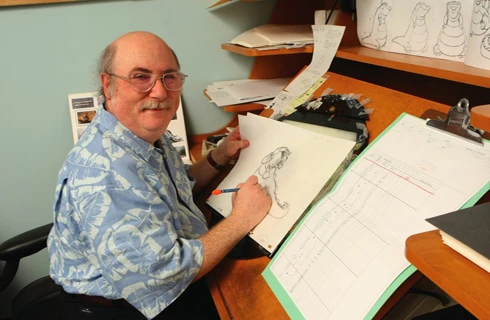


"This is the bridge," Gladstone says. "This is when someone may be a serious artist. If they draw things they see - the real world - that is a big jump. The intent to interpret what they see in the three-dimensional world is, for me, the tell-all that somebody's interested in art in a serious way."

Getting to that "bridge," that third phase, though, requires passing through phase two - easier said than done.

Gladstone explains, "Most young people who start drawing are trying to make things as accurate as possible. They work very hard to get the eye right, and that's where a lot of people get discouraged.

"There's a certain strength in being an artist, he says "in that at some point every artist I know is trying to draw Mom or Dad and somebody will come up behind them and say `that doesn't look like that.' This is when many people's art career ends."

He continues, "The only time they'll draw again is if they can copy something exactly, which is why many people are good at drawing from a picture, but they can't do the other [draw from life]. The person who is strong enough to say `So what? It's my version of this'- that's another step."

Practice is paramount to maturing as an artist. "Go to the zoo and sketch: draw your friends," Gladstone suggests. "Drawing people and their animals, trying to capture something that's moving - this kind of thing comes with time. It's not something that many children do early on. It comes with experience."

Milton Gray, in his book Cartoon Animation: Introduction to a Career, recommends studying animated films frame by frame, using a VCR or laser videodiscs.


Gladstone agrees. "I had the opportunity to put an old-time print of "Pinocchio" on a Moviola and spent an entire night going through the scenes I like frame by frame and finding out how they created that movie.

"It won't teach you everything," he warns, but, "we still do that. We still study how [certain segments] were done - how did Frank Thomas approach this problem. It's a very good way to do things, but it's only one of the ways."

Hand-in-hand with practice is formal art training. A young person, brimming with talent though she or he may be, needs structured schooling to make animation a career.

"They're not going to get a job here when they're fifteen years old," Gladstone says. "We recommend not only high school, but additional schooling as well - hopefully a college degree."

This schooling would, of course, have art as its primary focus - not merely drawing, but other disciplines as well, such as painting and sculpting. Milton Gray recommends studying actors and books on acting, learning something of staging, choreography, and principles of music.

Beyond the fine arts, some background in history, geography, the life sciences, et al., makes for a more knowledgeable, flexible animator.

"You have to bring things to the table," Gladstone explains. "Half of doing Disney-style feature animation is the ability to draw, paint, run a computer, or whatever, but the other half is communication skill. We find that people who have some post-secondary education are more well-rounded, more adapted to the needs of our studio.


"We realize," he adds "that not everybody can go to college, but we seem to see more seasoned players if they have." Can you be an animator without being able to draw? Gladstone replies, "If a kid wants to do animation and he or she can't draw, there are ways to do that. There always have been ways to do that - stop-action, pixilation (which is stop-action using people instead of objects), things like that. Now there's another one, the computer. You don't have to learn to draw to learn how to animate on a computer."

He cautions, however, "Computer animators just have a very fancy electronic pencil. If they can draw traditionally, they're that much ahead of the game. In all the computer work that I've seen in my life, [work] that has really pushed the animation limits - not just the movement limits, there's a difference - the animators have either come from traditional areas or had good traditional skills."


These skills, be they traditional or high-tech, can be utilized in a variety of ways. An animated feature film employs the talents of a wide variety of artists. Animators make up a fairly small population of the people that create an animated film. There are also assistant animators; in-betweeners; breakdown, background and layout artists; effects animators; storyboard artists; visual development or inspirational artists; computer animators; and graphic designers - to name a few!

All these individuals work as a team (hence the importance of communication) during the long, arduous process of producing an animated film. Gladstone gives an example of how the artist (in this case the layout artist), director, and art director work together. These individuals interpret the storyboard into the various sets, backgrounds and foregrounds for each shot of an animated film.

"The layout artist has a lot to do with the lighting of the film, the scope, the way the camera moves through the sets," he explains. "The layout artist is in a very great way the cinematographer of an animated film, deciding what the camera is going to see and where the characters will be blocked in a scene."


The in-betweener has traditionally been looked upon as the first rung on the ladder of a animation career. Although there are exceptions, Gladstone says, "Most people come up through the ranks, starting as an in-betweener and working their way up to an animator. I think that's a good way to do it. Eventually, if they become an animator, they will have had the experience of the people that follow them up. They were there before."

So, the path is charted - now, where to go for the all-important formal instruction? There are many schools that offer good fundamental art programs and consistently produce graduates with the skills necessary to become Disney animators. These schools are by no means the only choices available to the future animator.


Gladstone speaks from experience, "If you need to go to a state school - great! Find a state school that has an art program and take the best advantage of it you can. Learn how to draw well. Draw better than everybody there. If you can only go to trade school, great! Go to trade school and do it that way."

The various roads to an animation career all demand hard work, discipline, and patience. We asked Frank Gladstone what crucial advice he would give animators. He responded, "Keep trying. Don't get too frustrated. Realize your potential, be honest with yourself, and apply yourself to whatever that particular goal is you want to reach."

It takes, in a word, persistence!

Source:http://www.animationarena.com/becoming-an-animator.html

Thursday, December 13, 2012

Cat grooming basics


It is a known fact to my family, friends, and colleagues that Roopanand Rick is a cat lover. In fact, I am the proud owner of four mischievous furballs named Max, Gypsy, Dexter, and Paray. Owning a cat is not as easy as it sounds, and grooming one, much less four, is a potential nightmare, especially if you don’t know what to do.


Image credit: stuffpoint.com


While looking at cat videos (admit it, most of you do) on the Internet, sometimes I wonder why some cats look really nice and well-groomed, whereas others look like the complete opposite. Although some cats are born with really nice hair (or fur, if you prefer) and most cats take care of themselves well by preening and licking their hair to keep it clean, most of them will have snarls and mats if not properly groomed by their owners.

Here are some rules you need to follow.

• Never groom or clean your cat when it is stressed or in a bad mood, unless you like being scratched.

• Use a metal comb to brush your cat’s fur from head to tail. Be very gentle when brushing the chest and belly area.


Image credit: mypets.over-blog.ne


• The general rule in cat grooming is that the more hair your cat has, the more work you have to do. A short-haired cat needs less frequent brushing than a long-haired one.

• Most cats hate water. If you need to bathe your cat, be sure to be gentle and reward her with treats afterwards. Also, avoid pouring water on your cat’s eyes, ears, and nose.

• When trimming your cat’s claws, make sure to only use sharp, high-quality cat nail scissors and avoid the vein that runs into the nail.


Image credit: the-cat-guide.com
 

Remember that grooming sessions should be fun, for both you and your cat.

For more information about me (and my furry friends), visit this Facebook page.

Wednesday, November 21, 2012

Yahoo! News: ‘Kittycam’ study finds cats are virtual killing machines

The internet has showered a little bit too much of adoring attention to cats. As a cat lover myself, this cyber-phenomenon doesn’t come as a surprise. After all, what’s not to love about cats?
 

This often bloated characterization of cats often lead people to forget that they are, in fact, animals; hunting animals, to be more specific, with insatiable killer instincts that’s inherent in every predatory animal. This interesting article from Yahoo! News aims to provide a reality check for all internet-influenced kitty converts out there.
 
Cast aside all fantasies of your house cat frolicking through flower-filled fields in the afternoon sun. When kitty scratches at the door begging to go outside, it's the killing hour. USA Today reports that a study of outdoor feline behavior found that cats kill far more prey than previously believed. Research compiled by the University of Georgia found that 30 percent of roaming house cats kill an average of two animals per week.

"The previous estimates were probably too conservative because they didn't include the animals that cats ate or left behind," University of Georgia researcher Kerrie Anne Loyd says. Teaming up with National Geographic (creators of the Crittercam) for the study, 60 volunteers attached the so-called kittycams to breakaway collars that were placed around the necks of the cats. Each day, the previous evening's activities were downloaded and sent to the university research team.

The university study found that cats ate about 30 percent of their kills, brought home another 25 percent and left 49 percent of their prey to simply decay.

So what are cats killing?

Lizards, snakes and frogs (41 percent); chipmunks and vols (25 percent); insects and worms (20 percent) and, of course, birds (12 percent).

And while birds made up the smallest percentage of kills, some conservationists say the nation's 74 million house cats are to blame for dwindling bird populations.

"Cat predation is one of the reasons why one in three American birds species are in decline," George Fenwick, president of American Bird Conservancy, tells the paper.

But the study also found that cats pose just as much a risk to themselves as they do other creatures, with 45 percent crossing roadways, 25 percent eating and drinking items found outdoors and 20 percent exploring storm drains.